
What if software didn’t just assist you — but acted on your behalf? AI is no longer just a tool. It’s becoming a decision-maker. And the implications are enormous.
Imagine waking up to find your flights are booked, hotel confirmed, and calendar cleared — because an AI agent noticed a conflicting meeting, checked live pricing, made trade-offs, and executed the entire trip plan while you slept . No prompt. No approval. Just outcome.
This is the world of AI agents — and it’s already arriving. In this post, we’ll break down what AI agents are, how they work, where they’re being used, and why this technological shift is unlike anything we’ve seen before.
What Are AI Agents?
An AI agent is a software system that perceives its environment, makes decisions, and takes actions to achieve a specific goal — often with minimal human intervention.
Unlike a traditional AI tool that responds only when prompted, an autonomous AI system can initiate tasks, plan steps, recover from failure, and adapt its approach — much like a capable employee rather than a passive assistant.
“The difference between a tool and an agent is the difference between a hammer and a contractor. One does exactly what you do with it. The other figures out what needs to be done.”
The Core Loop
Every intelligent agent operates on a simple but powerful cycle:
This continuous feedback loop is what separates intelligent AI agents from static automation scripts. Agents don’t just execute — they evaluate and improve.
The Evolution: From Tools → Assistants → Agents
To understand the significance of AI agents, it helps to trace the three-stage evolution of AI in software systems.
Simple Tools — Rule-Based Automation
No memory, no context. Executes fixed instructions. If X then Y. A spell-checker, a chatbot decision tree, an autofill form.
AI Assistants — Context-Aware Responders
Understands language, remembers within a session, answers questions. Still user-dependent — it responds but doesn’t initiate.
Autonomous Agents — Goal-Driven Actors
Plans multi-step workflows, calls APIs, manages sub-tasks, adapts when blocked, and completes objectives end-to-end.
Side-by-Side Comparison
| Capability | Simple Tool | AI Assistant | AI Agent |
|---|---|---|---|
| Memory | None | Session only | Short + long-term |
| Planning | None | Minimal | Multi-step |
| Initiative | None | Reactive | Proactive |
| Tool Use | Fixed | Limited | Dynamic API calls |
| Adaptability | None | Low | High |
| Human Needed | Every step | Most steps | Goal only |
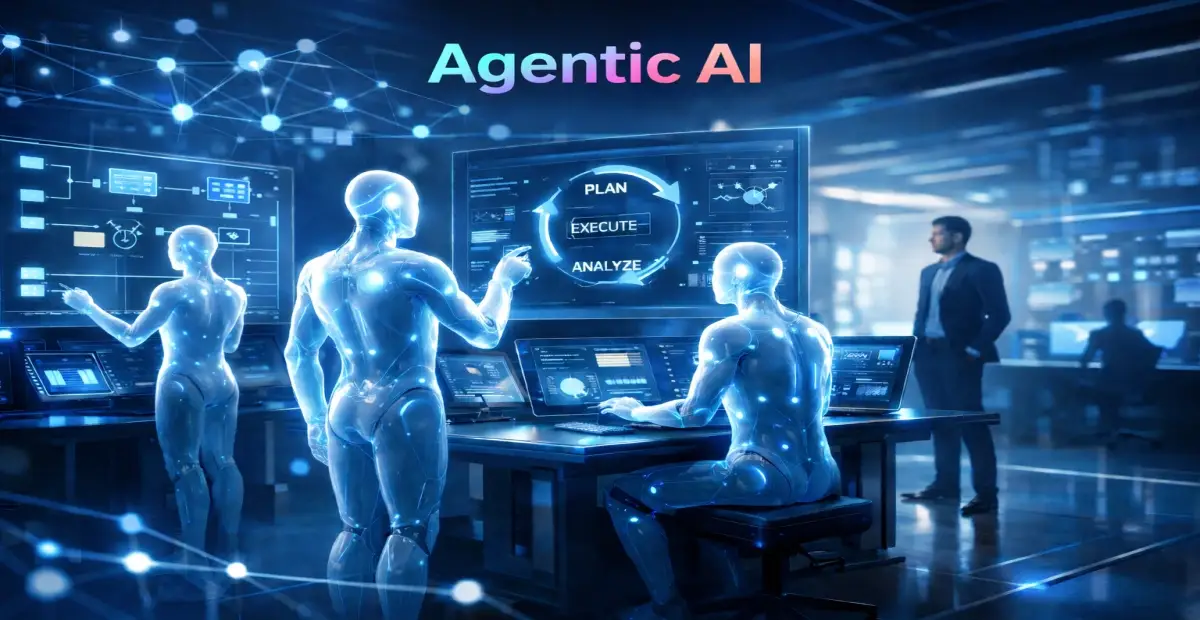
How AI Agents Work: The Architecture
Understanding how AI agents work requires looking at four interconnected layers that power their behavior. Think of it as a cognitive stack.
Perception
Reads inputs — text, files, APIs, sensors, web pages — to understand the environment.
Reasoning
Uses an LLM or decision engine to evaluate context, weigh options, and form a plan.
Memory
Maintains short-term context per task and long-term memory across sessions via databases.
Action
Executes via API calls, browser control, code execution, or triggering other agents.
The real power emerges when these layers work in a continuous loop. The agent acts, evaluates the result, adjusts its plan, and acts again — without waiting for human instruction at each step.
Real-World AI Agent Use Cases
AI agents use cases span virtually every industry. Here are concrete examples of how autonomous AI examples are already changing workflows:

Why This Shift Matters
The move from AI automation tools vs agents isn’t incremental — it’s a paradigm shift. We’re transitioning from tool usage to task delegation.
This changes the nature of human work. Instead of using software to complete a task, you assign a goal and review an outcome. The cognitive load shifts from execution to oversight — freeing humans to focus on strategy, creativity, and judgment.
✦ Benefits
- Dramatic reduction in manual effort
- 24/7 autonomous operation
- Scales without headcount
- Consistent, error-free execution
- Frees humans for high-value work
✦ Risks
- Reduced human oversight
- Difficult to audit decisions
- Single point of failure risk
- Job displacement concerns
- Unpredictable edge cases
Challenges and Limitations of AI Agents
For all their promise, today’s AI agents are far from perfect. Honest evaluation is essential to building trust — both in the technology and in the teams deploying it.
- Hallucinations & Incorrect Decisions: Agents built on LLMs can confidently produce wrong outputs, especially in unfamiliar domains or with ambiguous instructions.
- Reliability at Scale: Multi-step workflows multiply the chance of failure. One bad decision upstream can cascade into larger errors downstream.
- Lack of Control & Transparency: It can be difficult to audit why an agent made a specific choice — a serious issue in regulated industries.
- Security & Prompt Injection: Agents that read external content can be manipulated by adversarial inputs embedded in documents or web pages.
- Ethical & Legal Accountability: When an agent makes a consequential error, who is responsible? The user? The developer? The model provider?
These are not reasons to avoid agents — they’re reasons to deploy them thoughtfully, with proper guardrails, monitoring, and human-in-the-loop checkpoints where stakes are high.
The Future of AI Agents
In the next 3–5 years, the future of AI agents will be defined by greater autonomy, specialization, and collaboration between agents themselves.
Multi-Agent Systems
Teams of specialized agents collaborate — one researches, one writes, one reviews — like a digital workforce.
Fully Autonomous Workflows
Entire business processes — from lead to contract — executed end-to-end without human initiation.
AI Managing AI
Orchestrator agents will spin up, monitor, correct, and retire sub-agents — creating self-organizing systems.
Persistent Identity
Agents will maintain long-term memory and preferences across months of interaction — becoming genuine digital colleagues.
The question is no longer if this future arrives — but whether the organizations, regulations, and ethical frameworks we build will be ready for it.
Key Takeaways
TL;DR — What You Need to Know
- AI agents are goal-driven systems that plan and act — not just respond.
- They go beyond passive tools by initiating tasks without step-by-step instruction.
- Their architecture combines perception, reasoning, memory, and action in a continuous loop.
- Real-world applications already span support, coding, operations, and productivity.
- The shift from tool use to task delegation will reshape how humans and software collaborate.
- Deployment must be paired with oversight, transparency, and ethical guardrails.